

Every dive begins with a person. Before the first descent, that person already brings a body, a history of learning, expectations about the day and a way of deciding what can be said aloud. The equipment matters. So does the person inside it.
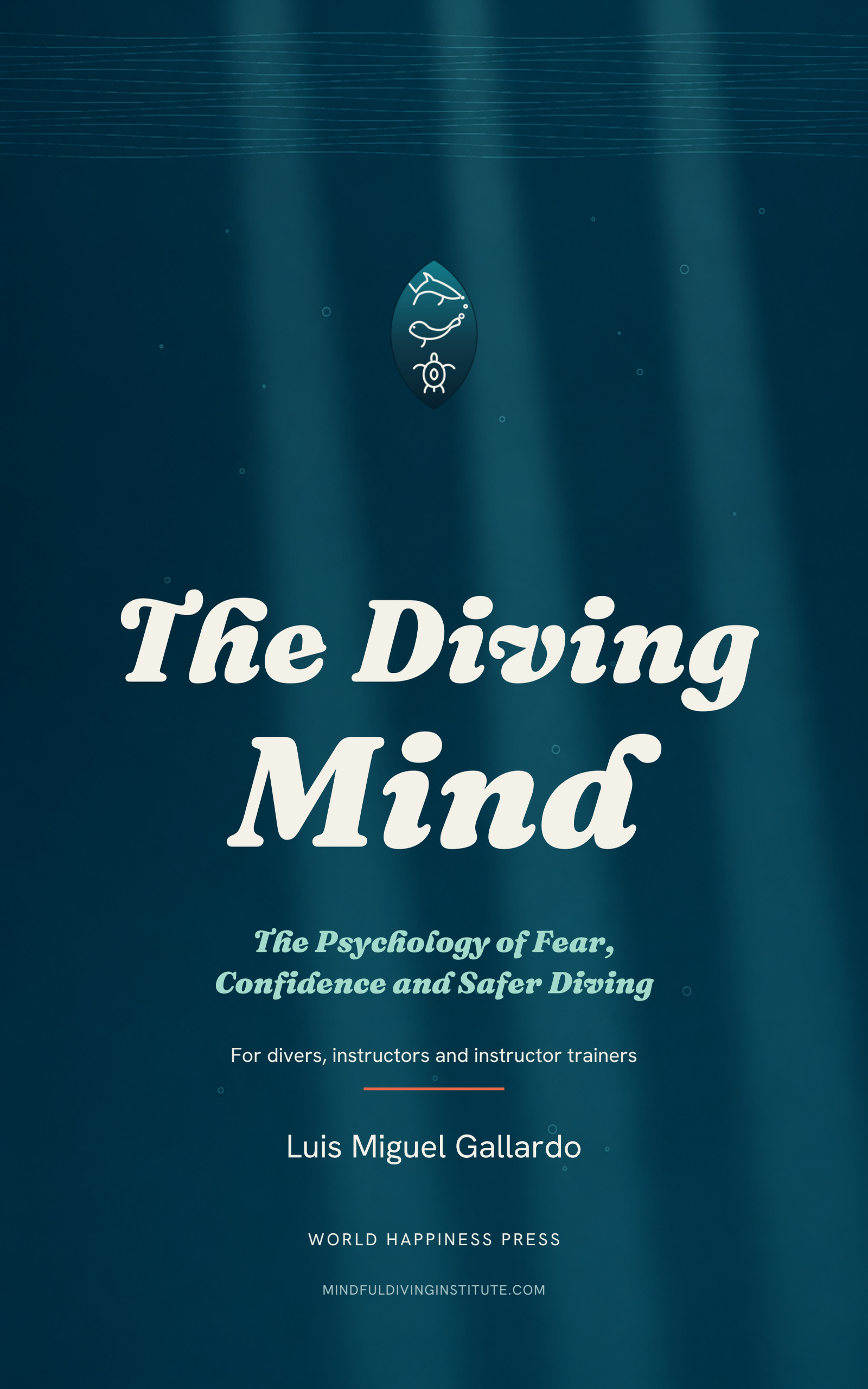
I wrote The Diving Mind to stay with that person for longer: to explain why a familiar skill can become difficult, why reassurance can miss the concern, and why an instructor's response to a question can shape the next question a student is willing to ask.
The book is the third part of a connected body of work. Mindful Diving opens the inquiry through presence and our relationship with the ocean. Mindful Breath follows the breathing person through preparation, immersion, intervals and life beyond the dive. The Diving Mind asks how body, interpretation, emotion and social context become learning and action.
From presence to understanding
Presence is a beginning. When I notice hesitation, I still need to understand what it concerns. If I notice my own impatience, I still need to decide what to do with it. Awareness becomes educationally useful when it changes the quality of the next observation, explanation or decision.
Imagine a fictional case: Alex asks to repeat the briefing. The instructor thinks, “He lacks confidence.” Alex may indeed feel unsure, but he may also have heard two different instructions from two different people. If I rush to improve his confidence, I can leave the contradiction untouched.
The better question is specific: “Which part needs clarifying?” If the answer reveals inconsistent instructions, the instructor has something concrete to correct. Alex's willingness to ask was a resource. Treating doubt as a defect would have concealed it.
This is the missing layer I want the book to develop: an explanation of the relationships between what a person feels, what they believe is happening, what the situation demands and what they can do next.
Why the breathing book belongs in the same conversation
It would be easy to write about fear as though it occurred only in thought. Mindful Breath keeps the body in view. Exertion, discomfort, respiratory demands and attention to bodily sensations belong in the account of a dive. A psychological interpretation should never make us less attentive to a physical problem.
The new book makes that boundary explicit. It offers no universal breathing count for underwater distress. Breath-holding, skip-breathing, deliberate hyperventilation and practising tolerance of air hunger are not its answer to a struggling scuba diver. The trained response to the actual situation, appropriate assistance and medical assessment when indicated come first. Reflective work follows.
That boundary protects the depth of the inquiry. We can be interested in meaning while remaining precise about physiology and professional responsibility. An experience does not become less human because it needs an operational or medical response.
The words deserve more care
Fear can concern a threat that feels present. Anxiety often reaches towards what might happen. Doubt asks whether something is known, understood or trustworthy. Panic can describe a powerful experience of fear, a clinical event or a diver's loss of effective action; those meanings should not be collapsed. The book explores their relationships without treating them as a single category of failure.
“Stress” also needs care. Epel and colleagues' review distinguishes stressors, responses and timescales. The question I bring to teaching is concrete: “What is making this difficult today?”
The answer can lead to a clearer explanation, a changed arrangement, more appropriate practice, a decision to postpone or a referral beyond the instructor's role. One reassuring sentence cannot do all of those jobs.
Fundamental Peace becomes credible in small actions
My work on Fundamental Peace runs through the book. Its four capacities give me questions to bring to an ordinary teaching day. Can my attention move when new information arrives? Can I acknowledge different feelings without disowning them? Can I loosen the image of myself that makes a correction difficult? Can I examine an error with compassion and responsibility?
These questions are more useful to me than demanding a permanent state of calm. I can be disappointed and still respect a limit. I can feel uncertain and still seek the information needed for a bounded decision. I can care about a student's progress and acknowledge that a colleague may be better placed to help.
The connection to diving is an educational proposal, open to observation and criticism. A person can use the practices without adopting my terminology. What matters is whether communication becomes clearer, decisions become better informed and teaching responds to the learner in front of us.
Emotions are invitations to inquire
In my work on Shadow, Gift and Essence, I explore how a difficult pattern can be examined without making it the whole identity of a person. The eleven emotion families in Emotional Alchemy in Rural India extend that reflective vocabulary. They are an author framework, not a consensus clinical classification. Findings from a community programme cannot establish effectiveness in diving.
In practice, anger might bring an unclear boundary into view. Envy might reveal something I want to learn. Fear might make preparation more careful. Each interpretation needs checking. Anger does not prove that another person has wronged me; fear does not establish either danger or safety. Nor does anyone owe us a positive meaning for their pain.
The six-wounds framework belongs to that same voluntary inquiry. I follow the vocabulary in my primary account of the six wounds and their associated virtues. In a dive centre, the useful question concerns the culture we create. Does it welcome a concern, respond respectfully to a limit and make repair possible after an error? It does not require an instructor to identify a student's hidden wound.
The instructor's coaching mindset
My transpersonal coaching work asks me to listen beyond the first explanation. A wish to dive may involve exploration, belonging, achievement or recovery of trust. Those meanings can matter when the learner chooses to discuss them.
I bring that stance into instructor education through curiosity, consent, clear agreements and review. “What did you expect?” may uncover a misunderstanding. “What support would help?” may reveal a practical adjustment. “What happened when we changed that?” makes reflection answerable to experience.
The instructor also has duties that require direct teaching and firm decisions. Coaching becomes unhelpful if the student must guess an essential instruction, negotiate a required standard or disclose personal history to be treated respectfully. During an emergency, reflective questioning gives way to the response the situation requires.
A diver can adopt the same mindset as a buddy: ask without assuming, listen without immediately fixing, state one's own limits and check shared understanding. This is a way of participating responsibly, not an additional clinical role.
The reference I want this book to become
I want readers from different agencies to find a book they can return to when a teaching problem needs more than a slogan. That ambition creates an obligation to explain, cite and remain correctable. Existing rescue education already contains psychology, stress recognition and progressive teaching. The contribution here is the sustained connection between mechanisms and everyday decisions.
The Diving Mind contains 24 chapters, 20 illustrations, nine practical appendices and 92 annotated references. Its cases are teaching constructions unless identified otherwise. Its evidence review separates established findings, applications proposed for diving and contemplative interpretations. It does not turn a vision of care into a claim that accident prevention has been demonstrated.
If the three books have a shared movement, it is this: attend to what is here; include the body; question the interpretation; choose an action; return and learn. The ocean can invite that movement. Whether we carry it into our conduct remains our work.
Read the books
Start with Mindful Diving, continue with Mindful Breath, or enter through The Diving Mind. The new book is also available as La mente del buceador in Castilian Spanish. Published by World Happiness Press, each language edition of the new EPUB costs €11.11, with any applicable tax shown at checkout.