The Integrative Transformation Model, Peer-Reviewed
Issue 25 of the Integral Transpersonal Journal carries the Integrative Transformation Model: five stages, seven mechanisms, the Shadow–Gift–Essence process, and two instruments…
De un vistazo
Resumen asistido por IA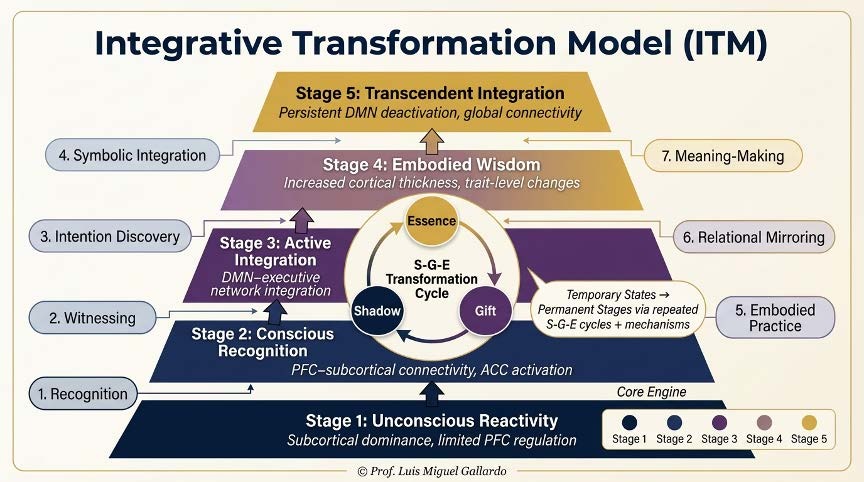
The Integrative Transformation Model — the framework beneath the Foundation's coaching, hypnotherapy and research — has been published in the Integral Transpersonal Journal, the official journal of EUROTAS. Here is what the paper says, and how it holds the rest of the work together. By Prof. Luis Miguel Gallardo · 27 October 2026
The news
Issue 25 of the Integral Transpersonal Journal (ITJ) is out this week, and it carries my paper The Integrative Transformation Model: Bridging Transpersonal States and Developmental Stages Through Shadow Integration (pp. 74–100). The ITJ is published in Milan by the Integral Transpersonal Institute under the scientific direction of Pier Luigi Lattuada, and it is the official journal of EUROTAS, the European Transpersonal Association — the same community that hosted my keynote Return to Origin in Greece a few days ago. Sharing an issue with Xavier Bronlet and Pier Luigi Lattuada's five-dimensional model, Regina Hess's pluriversal ecology and Sara Gambelli's work on the subtle levels in organisations is good company, and I am grateful to the editors and reviewers. In her editorial, Rossana Strambaci places the paper under the issue's theme of interruption — the moments when a flow is broken and something else can begin — and describes its intention precisely: "to consolidate a verifiable therapeutic approach." That is the ambition in one line.
- Read the article (PDF, author's copy, 27 pages)
- The journal: Integral Transpersonal Journal at EUROTAS · vol. XXV, n. 25, October 2026 · Issue DOI 10.32031/ITIBTE_ITJ_25
What the paper argues
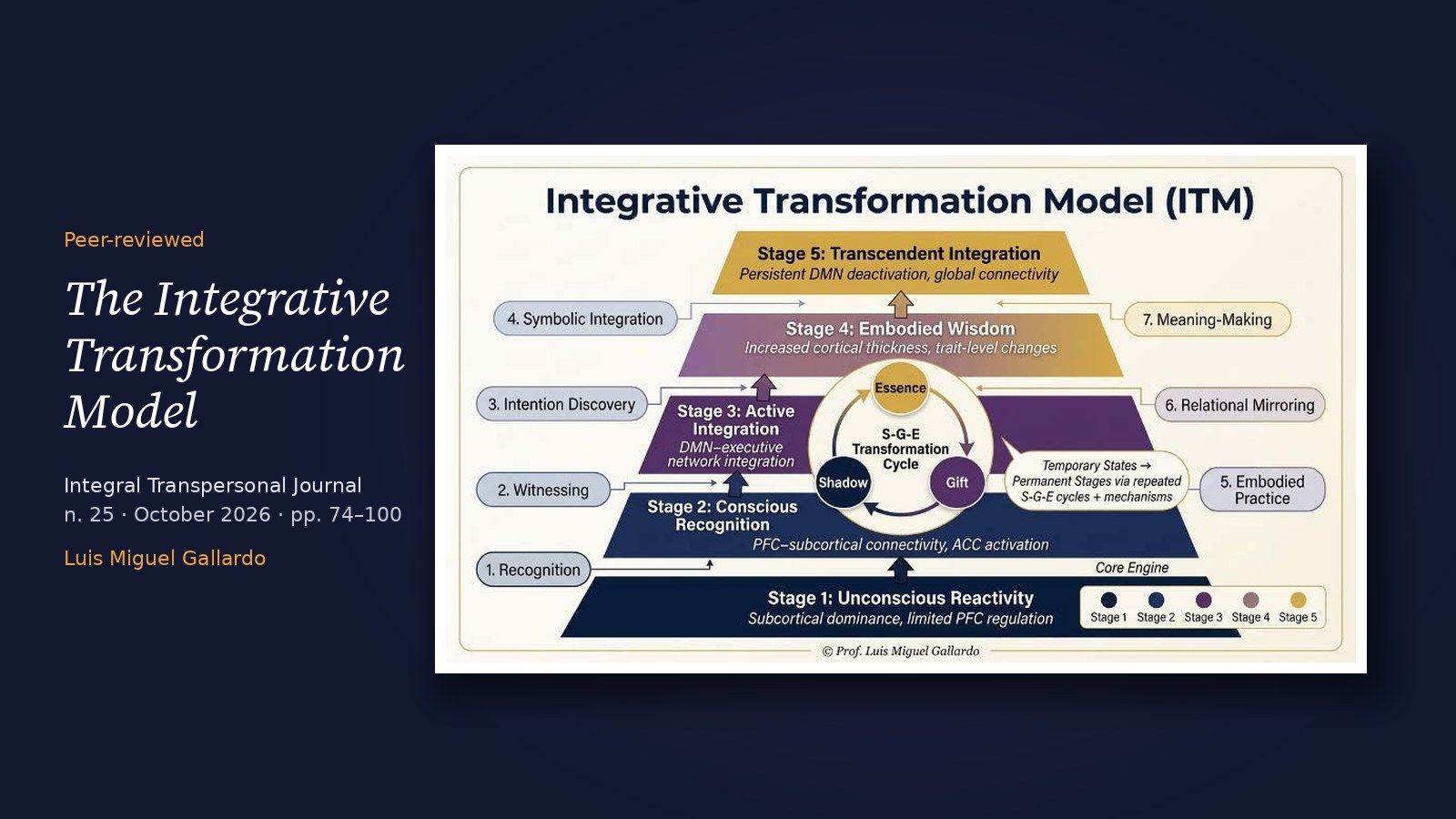
Transpersonal psychology has a fifty-year-old problem it rarely names out loud. We have beautiful descriptions of peak states — the retreat, the ceremony, the breath that opens the sky — and we have careful maps of developmental stages. What we do not have is an account of how one becomes the other: how a temporary state of consciousness turns into a permanent capacity. People come back from the mountain and, within a month, are the person they were. The Integrative Transformation Model (ITM) answers that the bridge is shadow integration. Not as one practice among many, but as the mechanism itself. The paper sets out:
- Five stages, from Unconscious Reactivity through Conscious Recognition, Active Integration and Embodied Wisdom to Transcendent Integration — each with phenomenological markers and the neurobiological signatures that current contemplative neuroscience can support, and each understood as an expanding capacity rather than a rank.
- Seven mechanisms that carry a person from one stage to the next: recognition, witnessing, intention discovery, symbolic integration, embodied practice, relational mirroring and meaning-making.
- The Shadow–Gift–Essence (S-G-E) process at the centre: the recognition that what we reject in ourselves holds an adaptive capacity in distorted form, and that essence — compassion, courage, wisdom, creativity — emerges when the shadow is metabolised rather than bypassed.
- Two instruments for testing all of this: the ITM Stage Assessment (ITMSA, 50 items) and the ITM Mechanism Inventory (ITMMI, 70 items across the seven mechanisms). Preliminary psychometrics on 250 respondents show good internal consistency (α = .82–.91), four-week test–retest reliability of .78–.86, and convergent validity with the Washington University Sentence Completion Test, the Postconventional Personality Assessment, the Five Facet Mindfulness Questionnaire and the Self-Compassion Scale. Both instruments are available to researchers and clinicians on request.
The practical consequence is the one I care about most. If shadow work is the pathway rather than the preliminary, then practitioners stop using meditation, ceremony or coaching to step around difficult material — spiritual bypassing — and start working directly with it, trusting that the gift and the essence will come through the integration. The model is deliberately falsifiable: it makes predictions about sequence, mechanism and outcome that evidence can refine or reject.
Why this is the keystone
Readers of this site will recognise the ITM as the grammar under almost everything I do. Having it peer-reviewed matters because the other pieces lean on it. Fundamental Peace and the FP20. The ITM describes the road; Fundamental Peace describes the destination — flexible attention, emotional coherence, a self held lightly, compassionate self-awareness — and the FP20 scale measures whether someone is actually arriving. Stage 4 of the ITM, Embodied Wisdom, is what a high FP20 looks like from the inside. The two instruments were built to be read together, and the Foundation's ITM Assessment puts them side by side. The Six Wounds and the Shameless Business. The Integrative Emotional Alchemy Framework — accepted this month in Frontiers in Psychology — applies the Shadow–Gift–Essence movement to six specific wounds and their virtues: Repression → Honesty, Denial → Ease, Shame → Humour, Rejection → Gentleness, Guilt → Forgiveness, Separation → Care. That framework is now in the field with artisan communities and head-office teams in Rajasthan through the Shameless Institutions programme, with the Shame and Release Scale and the FP20 in a pre-registered joint validation approved by the Foundation's own Institutional Review Board this week. The seven ITM mechanisms are the study's theory of change. Hypnotherapy and the Yoga Vāsiṣṭha. Recognition, witnessing and symbolic integration are what a regression session does when it works; my integrative review of age regression in the American Journal of Clinical Hypnosis earlier this year is the clinical side of the same argument, and The Mind That Makes the World traces the oldest version of it — the Yoga Vāsiṣṭha's teaching that the mind that makes the world can remake it — into modern practice. Leadership. ROUSER, The Transpersonal Leader and the Transpersonal Coaching Program teach the ITM as a way of leading: a leader who can recognise a reactive pattern, witness it, find the intention under it and stay present long enough for the gift to appear is doing Stage 3 work in a boardroom. The essay for leaders and changemakers and the piece on how the ITM integrates Ken Wilber's work are the accessible doors into the paper. Children, families, villages. The Meta Pets Method is symbolic integration for the youngest; the Happiness Ritual studied in my doctoral work at Shoolini University, and the Villages of Happiness programme that grows out of it, are embodied practice and relational mirroring at the scale of a community. The same seven mechanisms, in different clothes.
What comes next
Publication is a beginning. The paper proposes a longitudinal validation of the stages and a multi-method protocol — self-report, interview, physiological markers — and the Foundation's research platform is where that will run, alongside the SRS and FP20 work in India. If you teach, treat or lead with the ITM and want the instruments, scoring guidelines and psychometric documentation, write to lgallardo@worldhappiness.foundation. If you simply want to know where you stand, the ITM Assessment takes twenty minutes. The model's canonical presentation lives at The Integrative Transformation Model, now with the journal reference. The pain, met with consciousness, becomes love and compassion. That sentence has carried me for thirty years; it is good to see it in a journal, with numbers beside it.
How to cite
Gallardo, L. M. (2026). The Integrative Transformation Model: Bridging Transpersonal States and Developmental Stages Through Shadow Integration. Integral Transpersonal Journal, XXV(25), 74–100. Issue DOI: 10.32031/ITIBTE_ITJ_25.
Full record on this site: Research → The Integrative Transformation Model.
Un lector con IA entrenado solo en este ensayo. Prueba: «¿Qué quiere decir Luis con esto?» o «¿Qué se llevan los lectores con ansiedad?»
Las respuestas se basan solo en este ensayo — no son consejo médico.
Una pequeña práctica, extraída de este ensayo — una respiración de dos minutos y tres preguntas para reflexionar.
Una práctica amable — no es consejo médico.
Fórmate con Luis. Acreditación ICF · partner IIH.
Si este trabajo te mueve, puedes llevarlo más lejos — hasta hacerlo profesión. El Programa de Coaching Transpersonal integra hipnoterapia, liderazgo consciente y florecimiento humano en una formación completa con acreditación ICF, en colaboración con el Institute of Interpersonal Hypnotherapy (IIH).